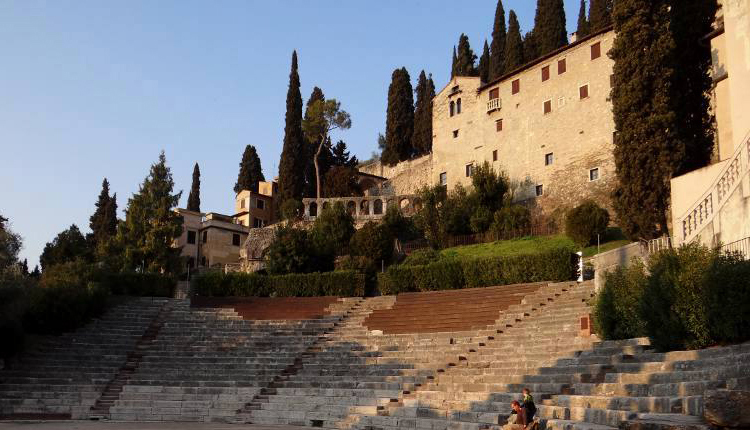
In ancient times, the left bank of the Adige was earmarked for entertainment. Indeed, in the 1st century BCE, a majestic theatre was built at the foot of Colle San Pietro, on a gallery of arcades lapped by the flowing river. Paintings and drawings from the past, by anonymous as well as famous artists, Palladio among them, reveal that it was a strikingly theatrical structure.

Over the centuries, the monumental theatre was gradually destroyed, eventually becoming the foundation for new buildings. It is entirely absent from the 16th-century fresco by Nicolò Giolfino and the 18th-century painting by Carlo Ferrari.

The ancient structure was rediscovered in the early 20th century, following an excavation campaign begun in 1834 by Andrea Monga. Today, the cavea, which was almost entirely recovered, hosts the cultural festivals that light up Verona’s summers with a steady calendar of plays, music and dance.

Don’t miss the Museo Archaeologico, which preserves the finds discovered during the excavation of the theatre. And be sure to climb up the steps that lead from the ancient Roman Ponte Pietra to the top of Colle San Pietro, for one of the best panoramic views of the city. From there, you can see the natural hilly amphitheatre that surrounds and protects the city. This was the very same view enjoyed by painters like Baldassare Longoni, author of one of the most picturesque views of Verona.


